


Table of Contents
Open source telecom infrastructure is built around a simple idea: critical systems should remain understandable, adaptable and under the operator’s control.
Telecom infrastructure itself is built to last.
A messaging gateway, routing layer or network service is not something an operator expects to replace every six months because a new software trend appeared. These systems sit in the middle of critical traffic, connect multiple networks and protocols, and often remain part of the infrastructure for years.
That is exactly why open source telecom infrastructure matters.
Not because the software is free to download. Not because open source is automatically better than commercial software. And certainly not because running telecom infrastructure suddenly becomes easy once the source code is available.
It matters because of control.
Open Source Is About Control, Not Price
The strongest argument for open source telecom infrastructure is not price. It is control.
The simplest interpretation of open source is usually about cost: no license fees, no expensive proprietary platform, no vendor charging for every additional feature.
That is only part of the picture, and in telecom it may not even be the most important part.
The real difference is that an open source infrastructure component gives you access to the system you are actually depending on.
You can inspect how it works. You can understand how a protocol is implemented. You can trace what happens to traffic as it moves through the system. You can modify integrations when your environment changes. You can build around it without waiting for a vendor to decide that your requirement belongs on a product roadmap.
For infrastructure teams, that changes the relationship with the technology completely.
Instead of renting access to someone else’s decisions, you gain the ability to make your own.
Telecom Infrastructure Rarely Lives in Isolation
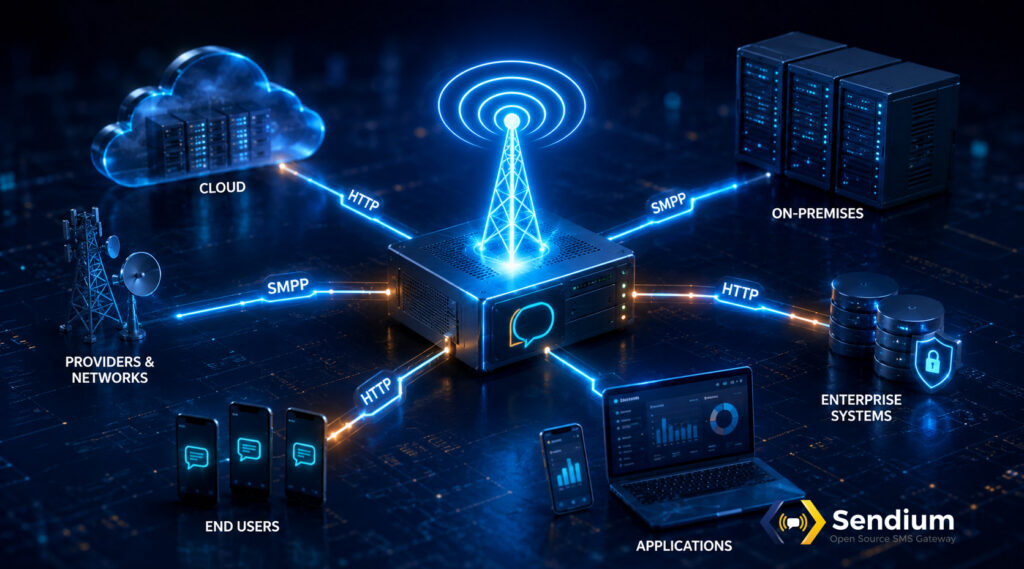
Open source telecom infrastructure becomes particularly valuable in these environments because it can participate in a wider ecosystem instead of forcing that ecosystem to adapt around a closed platform.
Modern telecom environments are rarely built around one protocol, one vendor or one deployment model.
A messaging operation may need to communicate with upstream providers over SMPP while exposing HTTP interfaces to applications. Another environment may involve SMPP on both sides. Routing requirements may differ between customers, providers or destinations. The same principle applies to configuration: infrastructure becomes easier to operate when changes do not automatically require disruptive restarts. Some services may run on-premises, others in public cloud infrastructure, and others in a hybrid architecture.
This makes interoperability fundamental.
Closed platforms can support interoperability too, of course. But when a proprietary product becomes the central point between multiple systems, the organization also becomes dependent on what that vendor chooses to expose, support and maintain.
Open source changes that boundary.
If an integration behaves unexpectedly, engineers are not restricted to documentation and support tickets. They can inspect the implementation itself. If a new operational requirement appears, the platform can potentially evolve with it instead of forcing the surrounding infrastructure to adapt around a black box.
That flexibility becomes increasingly valuable as telecom infrastructure moves further into cloud-native and software-defined architectures.
ETSI itself now develops production-grade open source telecom software through initiatives such as Open Source MANO (OSM), designed for management and orchestration of virtualized and cloud-native network services across heterogeneous environments. The project explicitly focuses on interoperability and multi-vendor ecosystems.
Vendor Independence Is an Architectural Requirement
Vendor lock-in is often discussed as a commercial problem.
In infrastructure, it is also a technical one.
What happens if a product is discontinued?
What happens if its licensing model changes?
What happens when the next version removes something your operation depends on?
What happens when your infrastructure needs to move somewhere the vendor does not support?
These are not hypothetical concerns when systems are expected to remain operational for many years.
With proprietary infrastructure, the organization may technically own its data and configuration while remaining dependent on somebody else to make the software continue working.
For operators, open source telecom infrastructure creates an alternative to making long-term architecture dependent on the commercial decisions of a single vendor.
Open source provides another option.
It gives organizations an exit path.
Even if the original maintainer changes direction, the software does not simply disappear behind a commercial decision. The code can be maintained internally, supported by another organization, forked when necessary or incorporated into a different architecture.
That does not eliminate dependency. Every serious technology has dependencies.
It does, however, change who ultimately has control over them.
And the telecom industry appears to recognize that value. The Linux Foundation’s 2025 Open Source Networking Study found that 92% of surveyed organizations considered open source a priority for agility, innovation and vendor independence.
Transparency Matters When the Software Handles Critical Traffic
This is where open source telecom infrastructure has a practical operational advantage: engineers can inspect the technology responsible for processing critical traffic.
Telecom systems do not simply process anonymous application requests.
They determine where traffic goes, when it is accepted, how it is routed, how delivery information is handled and how applications interact with external networks.
When something goes wrong, operators need answers. That is also why SMS gateway observability has to expose what happens across connections, routes and the message lifecycle.
Why was this message rejected?
Which connection handled it?
Why did traffic take this route?
Was the problem inside the gateway, at the provider, or further downstream?
A system that exposes its internal behavior is inherently easier to investigate than one whose internal logic is inaccessible.
This does not mean that open source automatically means secure or reliable.
Bad open source software is still bad software. An abandoned repository does not become production-grade infrastructure simply because its code is visible.
Open source still requires disciplined engineering: testing, patch management, dependency management, security reviews, monitoring and people who understand the system they operate.
The difference is that the organization has the ability to perform that work.
Transparency makes verification possible.
How Open Source Telecom Infrastructure Can Evolve With Your Operation
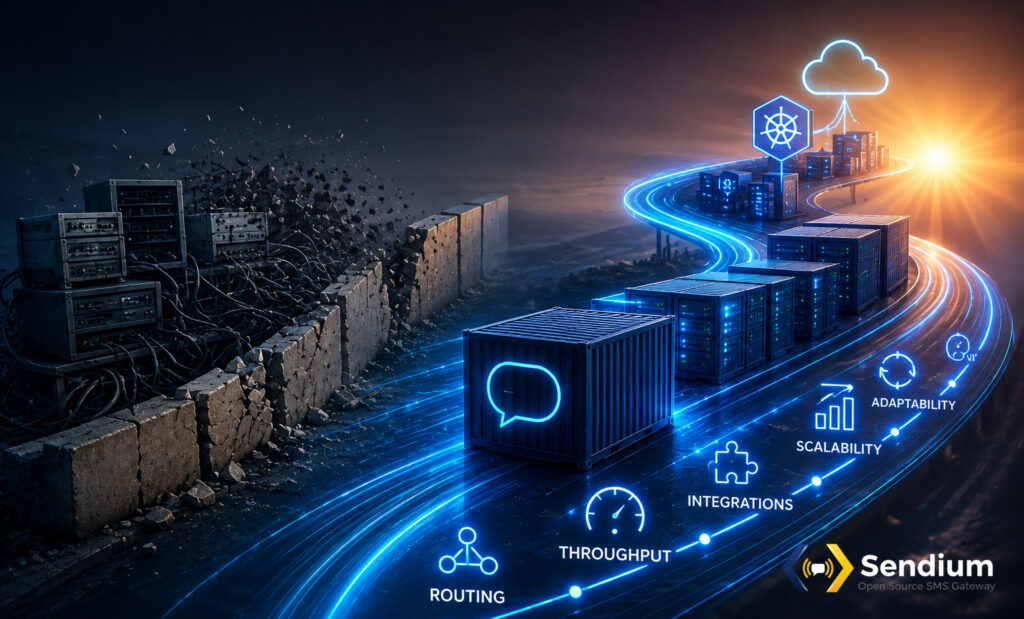
Telecom requirements change.
Traffic grows. Providers change. Routing policies evolve. New applications appear. Deployment strategies move from bare metal to virtual machines, containers or Kubernetes. Monitoring and observability requirements become more sophisticated.
Infrastructure that cannot evolve eventually becomes infrastructure that has to be worked around.
And workarounds accumulate.
A custom proxy is added here. An external routing layer appears there. Another service compensates for an API limitation. Operational knowledge gradually becomes distributed across several systems whose only purpose is to compensate for restrictions somewhere else.
Open source gives engineering teams another choice: change the infrastructure itself.
That does not mean every operator should maintain a private fork of every component. In most cases, they should not.
It means that when adaptation is genuinely necessary, the option exists.
That is an important distinction.
Open Source Does Not Remove Responsibility
There is also a mistake at the opposite end of the discussion: assuming that open source means infrastructure without ownership.
It does not.
Someone still needs to operate the platform.
Someone needs to understand capacity, routing, security, logging, monitoring, upgrades and failure scenarios.
Someone needs to decide when a new release is ready for production.
Open source does not outsource those responsibilities.
In some cases, it makes them more visible.
Organizations therefore need to distinguish between access to source code and a sustainable open source project. Documentation, release practices, governance, maintainability, community activity and architectural quality matter just as much as the license.
That is particularly important in telecom, where the consequences of poorly understood infrastructure become visible very quickly when production traffic arrives.
Why Open Source Telecom Infrastructure Is Moving Mainstream
Open source is no longer an experimental idea sitting outside mainstream telecom infrastructure.
Organizations including ETSI and the Linux Foundation are actively building open software ecosystems around network orchestration, automation and cloud-native telecom infrastructure.
In July 2026, for example, Deutsche Telekom contributed StratoWeave, an open source platform for large-scale network and service automation, to Linux Foundation Networking. One of the project’s stated objectives is giving operators greater control over their automation roadmap while reducing dependence on proprietary platforms.
The significance is not any single project.
It is the direction.
Telecom networks are becoming increasingly software-defined, distributed and programmable. As more intelligence moves from dedicated hardware into software, the ability to understand, integrate and control that software becomes strategically important.
Open infrastructure follows naturally from that transition.
Where Sendium Fits
Messaging infrastructure is a practical example of where open source telecom infrastructure becomes more than a theoretical argument.
An SMS gateway sits between applications, customers, providers and networks. It needs to handle different protocols, routing decisions, throughput limits, delivery receipts, inbound messages and changing operational requirements without becoming another opaque dependency in the middle of the messaging stack.
Sendium is open source because infrastructure like this should be inspectable and adaptable.
It supports SMPP and HTTP communication, configurable routing, per-connection TPS control, live configuration changes and MO forwarding, while remaining deployable in the environment that makes sense for the operator — on-premises, in the cloud or as part of a hybrid architecture.
The objective is not to make every telecom operator become a software vendor.
It is to make sure the gateway does not become the part of the infrastructure they no longer control.
Open Infrastructure Creates Options

Ultimately, open source telecom infrastructure creates something particularly valuable for operators: options.
That may ultimately be the most important argument for open source in telecom.
It creates options.
The option to deploy where you want.
The option to integrate with the systems you already operate.
The option to inspect what happens when something fails.
The option to extend the platform when requirements change.
The option to change support providers.
And, if necessary, the option to take responsibility for the technology yourself.
Telecom infrastructure is too important — and too long-lived — to evaluate only by what a platform can do today.
The better question is what happens when your requirements change tomorrow.
Open source does not guarantee that the answer will be easy.
It guarantees that the answer does not have to belong exclusively to someone else.