


Table of Contents
Modern applications deserve modern messaging infrastructure
Most technology stacks have changed dramatically over the last decade.
Applications have moved to the cloud. Development teams work with APIs, containers, microservices, automation platforms, observability tools, CI/CD pipelines, and real-time data flows. Business systems have become faster, more modular, and more connected than ever before.
Νevertheless, in many messaging environments, one critical component has not evolved at the same pace:
the SMS gateway.
For many companies, the gateway still sits quietly in the background, doing what it has always done: accepting messages, forwarding them to providers, and hoping everything works as expected.
And for a long time, that was enough.
But today, SMS is no longer just a simple notification channel. It is part of authentication flows, customer journeys, financial alerts, operational updates, two-factor authentication, emergency notifications, logistics communication, and high-volume A2P messaging.
The gateway is no longer just a technical connector. It is a critical control point, and that is exactly why relying on outdated gateway infrastructure can quietly become one of the biggest limitations in a modern messaging stack.
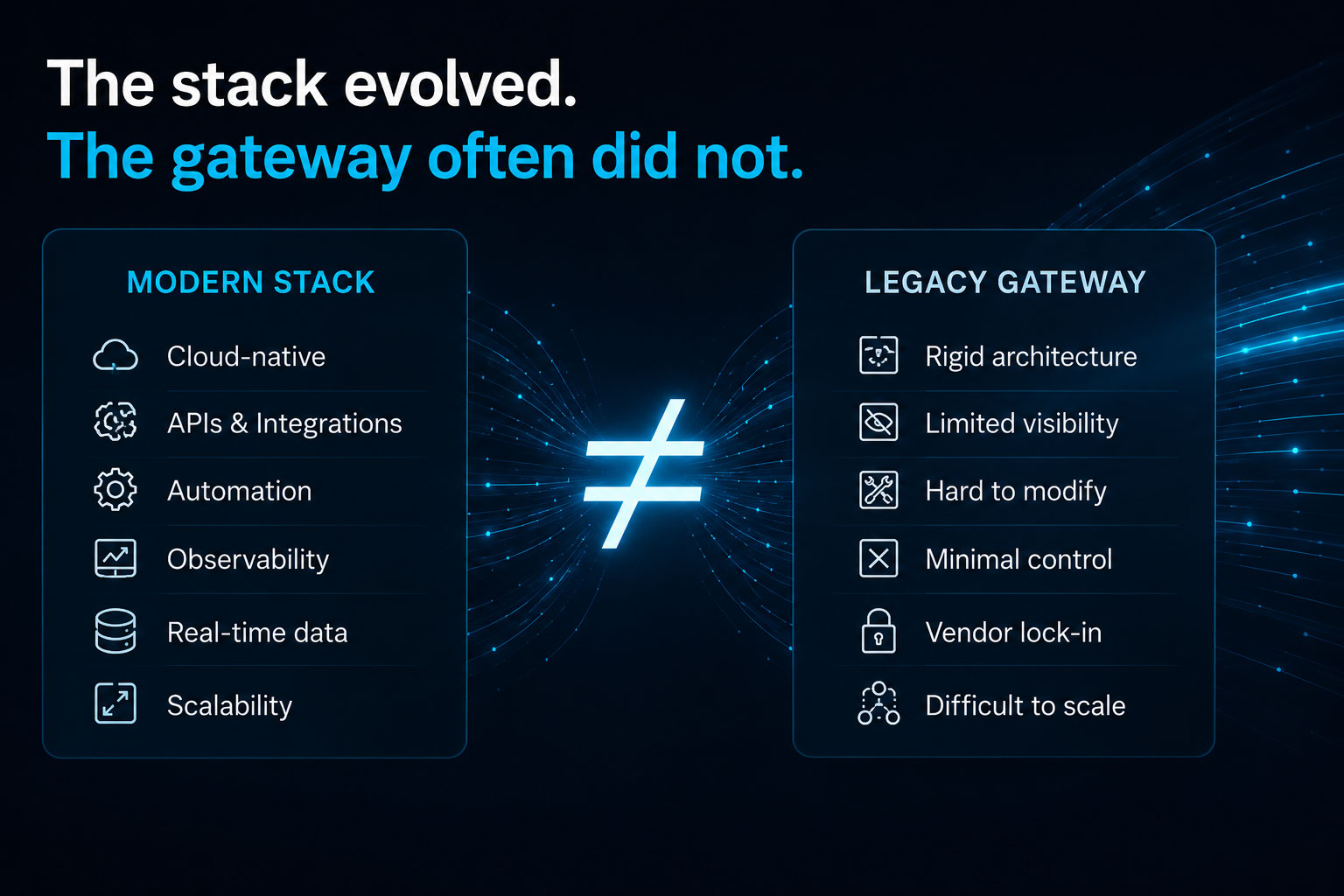
The stack evolved but the gateway often did not
Modern teams expect flexibility. They want to be able to:
- define how traffic moves.
- observe what happens in real time.
- change routing logic without unnecessary downtime.
- avoid being locked into a single vendor, single provider, or single architectural model.
However, many legacy SMS gateway environments were built for a very different era, when messaging flows were simpler, traffic volumes were lower, integrations were fewer, and operational expectations were different.
Back then, it may have been enough to connect an application to a provider and simply send traffic out. This is no longer enough.
Messaging teams need to answer questions like:
- Which route should this message take?
- What happens if a provider becomes unstable?
- How do we control throughput per connection?
- Can we change routing rules without restarting services?
- Can we inspect and understand what is happening before the message leaves our system?
- Can we extend the gateway to fit our business logic?
When the answer is “not easily,” the gateway becomes a bottleneck, and not because SMS is outdated, but because the infrastructure around it has not kept up.
The real problem is control
When a message leaves your system, your level of control decreases.Once it has been passed to an upstream provider, carrier, or aggregator, you are waiting for the next response: accepted, rejected, delivered, failed, delayed, expired.
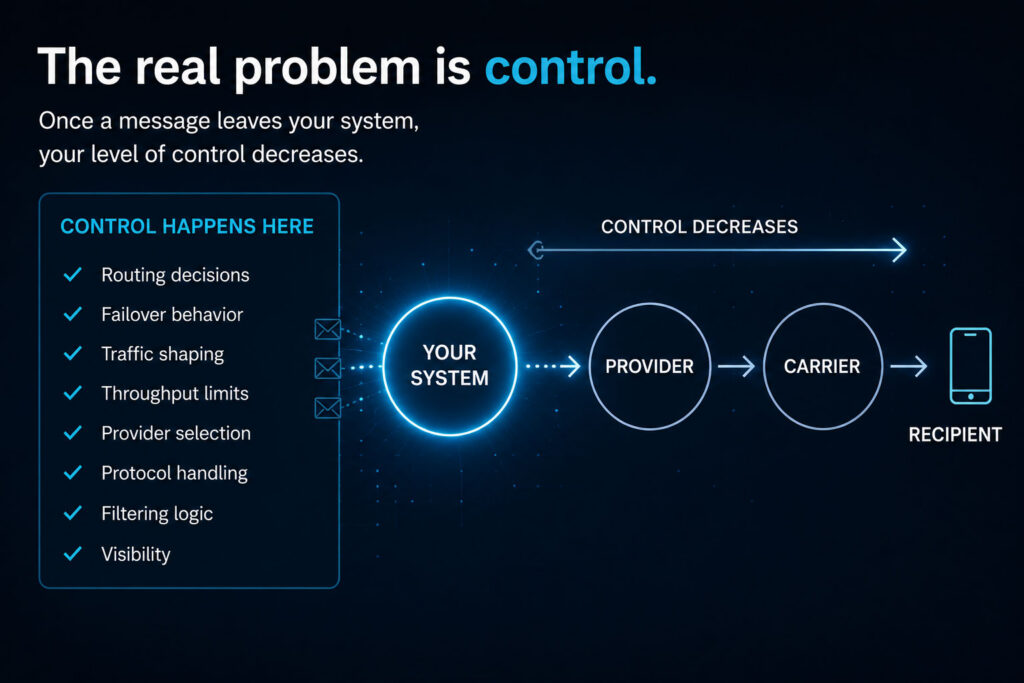
That means the most important decisions often happen before the message leaves your environment.
This is where gateway control matters:
- Routing decisions.
- Failover behavior.
- Traffic shaping.
- Throughput limits.
- Provider selection.
- Protocol handling.
- Filtering logic.
- Logging and visibility.
These are not secondary details, as they directly affect delivery quality, operational reliability, cost efficiency, and user experience.
A gateway that only forwards messages is useful, but a gateway that lets you control how messages move is far more valuable.
Legacy gateways create hidden friction.
The problem with older gateway infrastructure is rarely obvious at first, because the messages may still go out, the traffic may still flow and the systems may still appear to work.
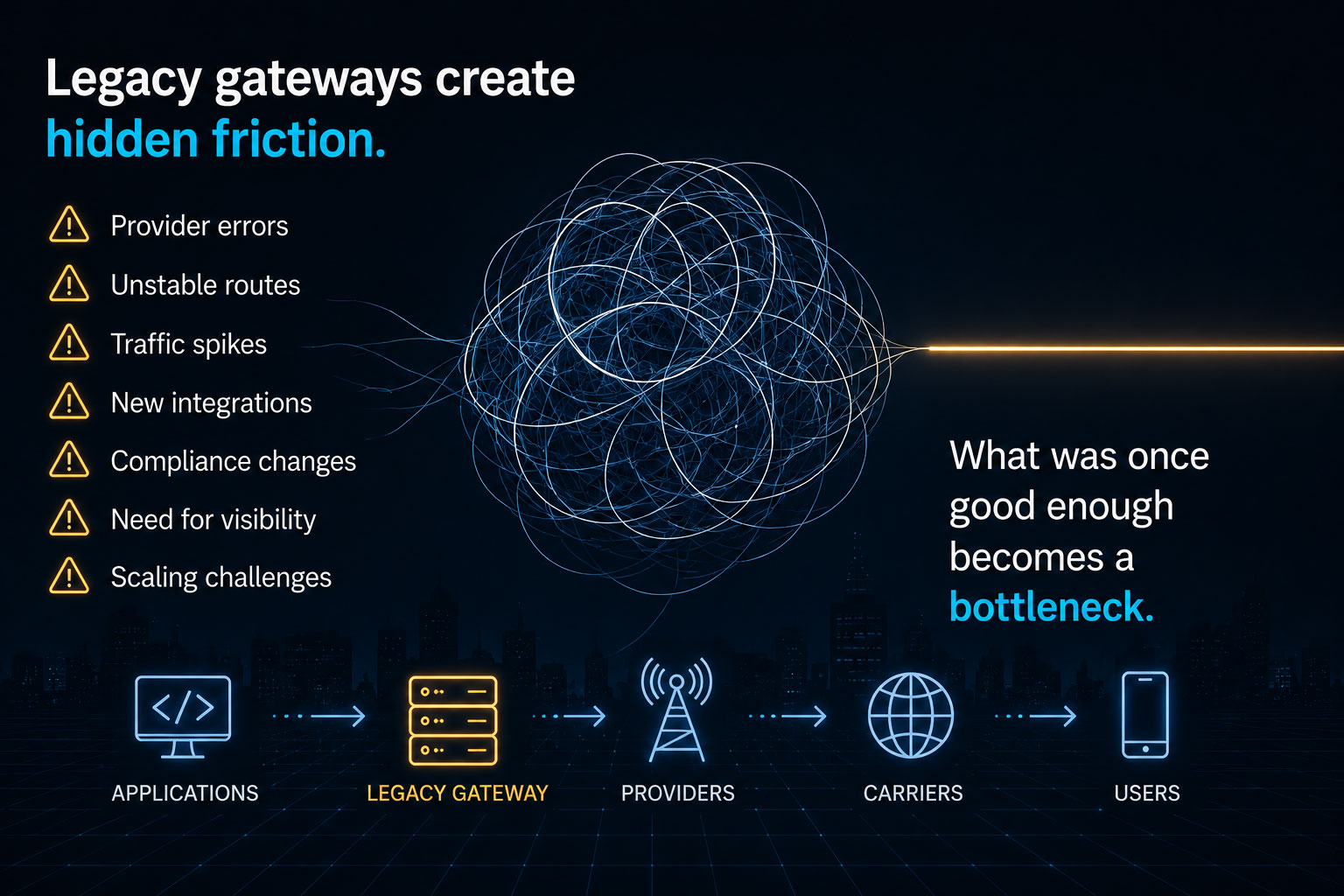
Nonetheless the friction becomes visible when teams need to adapt and their needs increase:
- A provider starts returning errors.
- A route becomes unreliable.
- Traffic volume increases.
- A new integration is needed.
- A customer requires specific routing behavior.
- A compliance requirement changes.
- A team wants better observability.
- A system needs to scale.
Suddenly, the gateway that was “good enough” becomes difficult to modify, difficult to extend, and difficult to trust. This is where teams often discover that their application stack is modern, but their messaging layer is still operating with old assumptions.
That mismatch creates operational drag, and in high-volume messaging, operational drag is expensive.
Messaging infrastructure should not be a black box
SMS infrastructure is too important to be treated as something opaque.
If a business depends on SMS for authentication, alerts, transactions, or customer communication, then the gateway should provide clarity, not mystery.
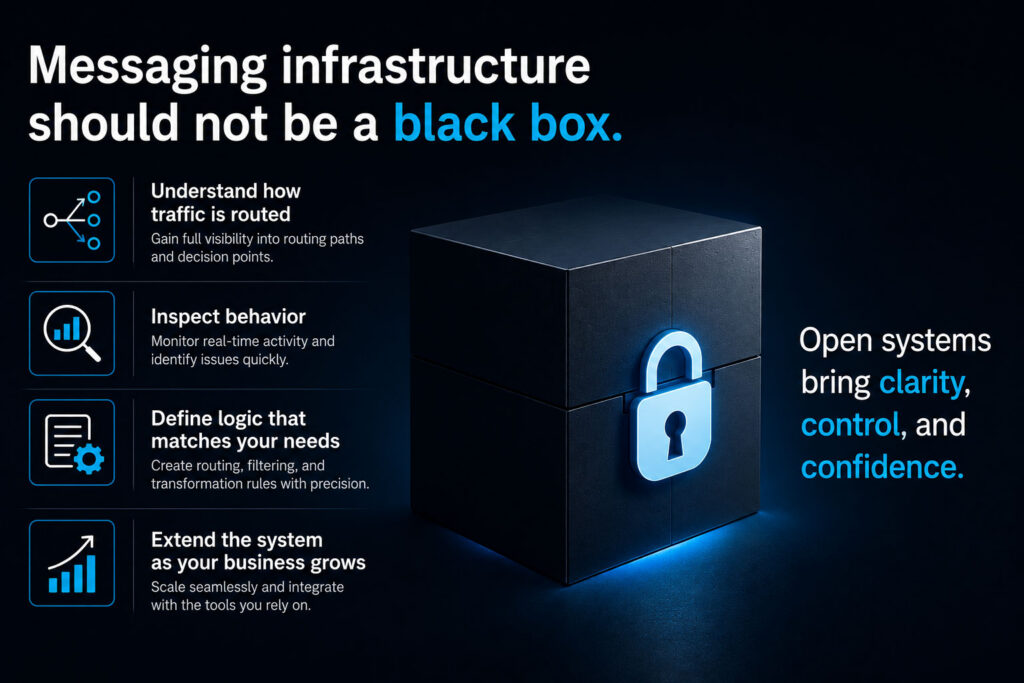
Teams should be able to understand how traffic is routed, inspect the system’s behavior, define logic that matches their needs and extend the system when the business requires it.
These are the reasons open infrastructure matters. Open systems give technical teams the ability to see, adapt, improve, and contribute. They reduce dependency on closed logic, make integrations more flexible, support ownership, and help teams build infrastructure that fits their use case instead of forcing the use case to fit the infrastructure.
In messaging, this is not just a technical preference. It is a strategic advantage.
What a modern SMS gateway should provide
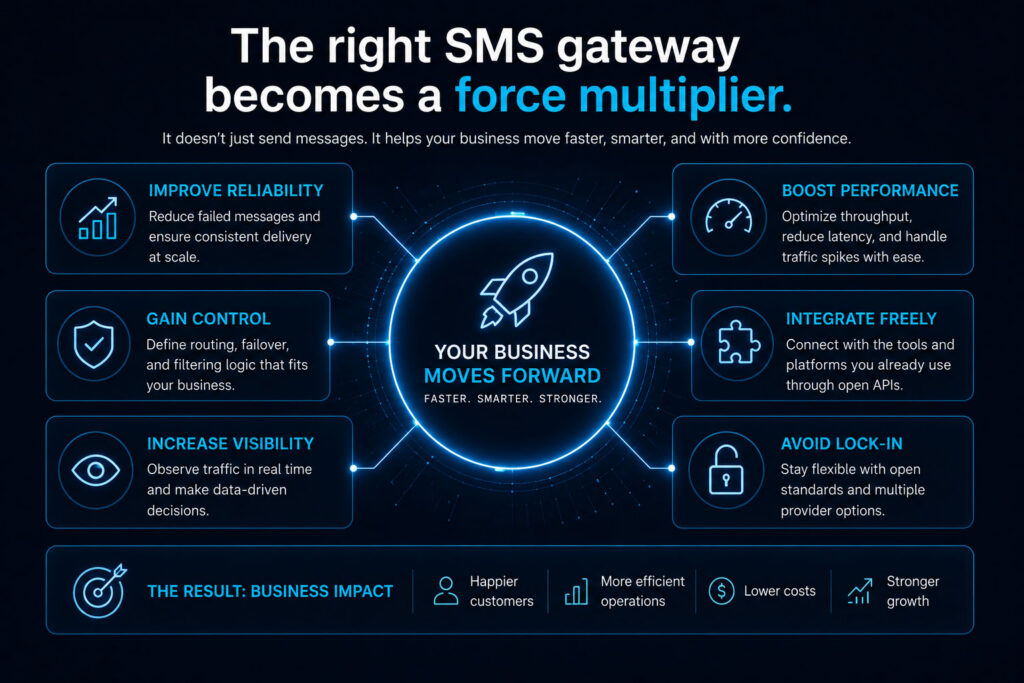
A modern SMS gateway function is to act as a flexible control layer between business systems and messaging networks, and not just to connect applications to SMS providers.
This means supporting the needs of developers, telecom professionals, CPaaS teams, enterprises, and infrastructure operators who need more than basic message forwarding.
A modern gateway should support:
Protocol flexibility
It should be able to work with common telecom and application protocols, including SMPP and HTTP-based integrations.
Routing control
It should allow traffic to be routed based on configurable logic, destination, provider behavior, traffic type, or operational requirements.
Failover handling
It should help teams respond when routes or providers become unstable.
Throughput management
It should provide control over TPS and connection-level performance.
Live configuration
It should allow teams to adapt without unnecessary restarts or heavy operational disruption.
Extensibility
It should be designed so teams can add rules, filters, integrations, and vendor-specific logic.
Deployment freedom
It should support different infrastructure models, including cloud and on-premise environments.
Most importantly, it should give teams ownership over their messaging layer, because the gateway is not just a connector, but the place where messaging strategy becomes operational reality.
This is where Sendium comes in
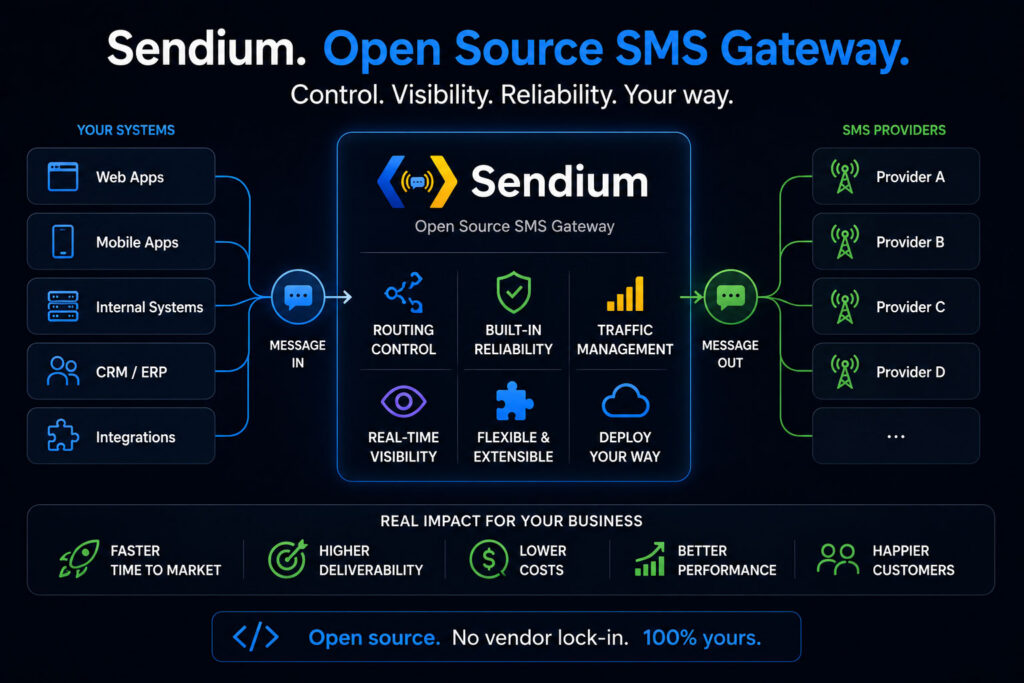
Sendium is being built for teams that want more control over their SMS infrastructure. It is an open source, headless SMS gateway designed for modern messaging environments where flexibility, visibility, extensibility, and ownership matter.
Sendium is built around a simple idea:
Messaging infrastructure should be open, controllable, and adaptable.
It is designed to sit between applications and SMS connectivity, helping teams manage how messages move through their infrastructure before they leave the system.
With built-in SMPP server and client, HTTP-SMPP bridging, routing logic, TPS control, failover handling, live reconfiguration, and extensible architecture, Sendium is being developed as a modern alternative for teams that do not want their gateway to be the oldest part of their stack.
The future of messaging infrastructure should not be locked inside black boxes, but it should be:
- Open
- Flexible
- Built for the people who operate, extend, and depend on it.
So, the question is not whether messaging is getting old. Maybe the problem and the better question is:
Is your gateway older than your stack?
Sendium launches on May 31.
Open source SMS gateway infrastructure, built for control. Take advantage of it and modernize your SMS infrastructure.