

Table of Contents
A container-native SMS gateway should do more than simply run inside Docker. It should fit cleanly into modern on-prem, cloud and hybrid infrastructure while preserving the operational realities of SMPP connectivity, TPS limits, routing, delivery receipts and inbound messaging.
For years, SMS gateway infrastructure was closely tied to the server it ran on.
Install the operating system. Configure the gateway. Add libraries and dependencies. Tune the environment. Connect it to the network. Then document everything carefully, because rebuilding that same server six months later could become a project of its own.
Containers changed that model.
But calling an SMS gateway “container-native” should mean more than putting an old application inside a Docker image.
Messaging infrastructure has some characteristics that ordinary web applications do not. SMPP connections are persistent. Providers impose TPS limits. Routes have operational consequences. Delivery receipts return asynchronously. Inbound messages have to reach the correct application. Network connectivity to operators and aggregators may involve VPNs, private links, firewalls and fixed IP addresses.
A container can make deployment easier.
It does not make those realities disappear.
What a Container-Native SMS Gateway Should Actually Mean
At its simplest, containerisation packages an application together with the environment it needs to run.
That already solves several practical problems.
Instead of maintaining different installations across development, testing and production environments, teams can deploy the same application image. Dependencies become predictable. Upgrades become easier to reproduce. Rollbacks become less dependent on somebody remembering exactly what changed on a server three weeks earlier.
That is useful.
Container-native architecture goes further.
The gateway should be able to operate without depending heavily on one particular machine. Configuration should be manageable externally. Logs and metrics should be accessible to the wider operational stack. Health should be observable. Deployments should fit naturally into automated infrastructure processes.
And importantly, container-native does not automatically mean Kubernetes.
A company may run a container on a single Docker host. Another may use Kubernetes, OpenShift or another orchestration platform. A telecom operator may run containers entirely inside its own data centre.
The deployment environment is a choice.
The gateway should not dictate that choice.
On-prem is not going away

There is a tendency in software discussions to treat on-premise infrastructure as something organisations are gradually abandoning.
Telecommunications is considerably more complicated than that.
SMS gateways frequently sit close to infrastructure that companies deliberately keep inside controlled environments.
An enterprise may want message traffic to remain inside its own network. An operator or aggregator may already have private connectivity to upstream providers. Security policies may require particular components to stay within specific infrastructure boundaries. Existing SMPP interconnections may depend on fixed addressing, VPNs or firewall rules that have been built around the company’s network topology.
In those environments, moving a gateway to the public cloud simply because “cloud is modern” may solve very little.
Containers still have a role.
An on-prem deployment can benefit from the same repeatability and cleaner lifecycle management that containers provide elsewhere. The company keeps control of the infrastructure while removing much of the installation complexity traditionally associated with gateway software.
Modernisation does not have to mean relocation.
Sometimes it means making the infrastructure you already control much easier to operate.
A container-native SMS gateway can modernize deployment without forcing telecom connectivity out of the environment the business already controls.
The cloud changes deployment - not SMS
Cloud infrastructure offers obvious advantages.
Provisioning is faster. Infrastructure can be automated. Development and staging environments can be created more consistently. Monitoring systems, CI/CD pipelines and broader application platforms may already be running there.
For companies building messaging products or integrating SMS into cloud-native applications, placing the gateway close to those systems can make architectural sense.
But SMS traffic does not suddenly behave like ordinary HTTP traffic because the gateway happens to run in AWS, Azure, Google Cloud or another provider.
An SMPP bind is still a persistent connection.
Your upstream provider may still enforce a defined TPS limit.
Your application may generate traffic much faster than the available SMS route can process it.
Network paths still matter.
Simply starting additional containers does not automatically increase the throughput your provider allows, and horizontally scaling a stateful messaging workload requires more thought than scaling a pool of stateless web servers.
That distinction matters.
Cloud-native operational practices are extremely useful for messaging infrastructure. Cloud assumptions should not replace an understanding of the messaging protocols underneath them.
Running a container-native SMS gateway in the cloud can simplify provisioning and automation, but it does not change the behavior of the underlying SMS protocols.
Hybrid is often the real answer
One of the most important MO use cases is opt-out handling.
When a user sends a stop keyword, the platform may need to update consent state, suppress future traffic, notify a customer system or trigger compliance logic. The exact behavior depends on the environment, the sender setup and the responsibilities of the platform, but the operational requirement is clear: the inbound opt-out must not get lost.
This is where inbound handling becomes directly connected to trust.
If an opt-out message is received but not routed correctly, the business may continue sending messages to someone who has already asked to stop. That can create customer frustration, support issues and compliance risk. Even if the gateway is not the final system of record for consent, it still plays an important role in making sure the inbound signal reaches the right place.
Reliable MO forwarding helps protect that flow.
It gives the surrounding platform the information it needs to act on user intent instead of leaving inbound traffic buried inside provider connectivity.
This is where a container-native SMS gateway becomes especially useful: the gateway layer can sit where telecom connectivity makes sense while applications live elsewhere.
The HTTP Side Matters
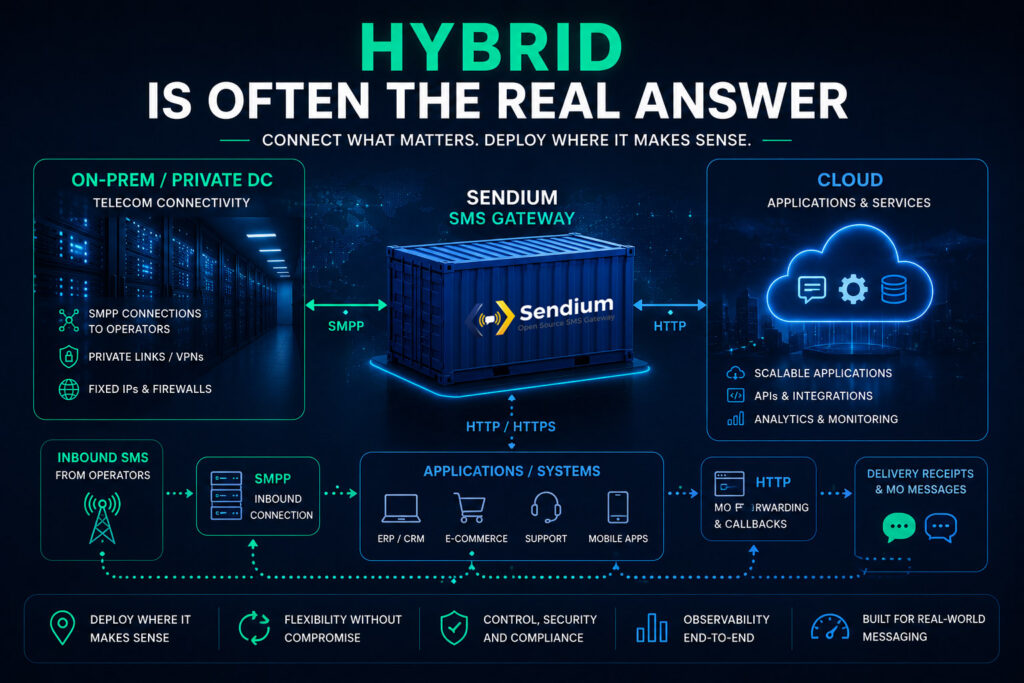
The most interesting deployment model may not be on-prem or cloud.
It may be both.
Consider an enterprise whose applications have moved to the cloud while its telecom connectivity remains inside a private data centre.
Or an SMS provider that maintains carrier interconnections in one controlled environment while exposing APIs to applications running elsewhere.
Another company may operate gateways in multiple locations for resilience or geographical reasons.
These are not edge cases. They are natural consequences of telecommunications infrastructure evolving at a different pace from application infrastructure.
A modern gateway therefore has to sit comfortably between different worlds.
Your application might communicate over HTTP from a cloud platform while the gateway delivers traffic through persistent SMPP connections.
Another system might communicate with the gateway through SMPP itself.
Inbound SMS may arrive through an SMPP connection and then need to be forwarded to an application-facing system over HTTP.
The useful question is not:
“Is our SMS infrastructure cloud or on-prem?”
It is:
“Where should each part of the messaging path run?”
Once that question is asked, hybrid architecture becomes much easier to understand.
Containers make movement easier
One of the strongest advantages of containerised infrastructure is portability.
Suppose a company initially deploys an SMS gateway on a virtual machine in its own data centre.
Later, it decides that a new application should run in a private cloud.
Perhaps another environment is added for disaster recovery.
The objective should not be to redesign the gateway every time the infrastructure changes.
Containers provide a much cleaner deployment unit.
The same gateway software can be incorporated into different operational environments while networking, configuration, security and capacity policies are adapted to the needs of each deployment.
That reduces one particular form of lock-in that receives less attention than vendor lock-in:
infrastructure lock-in.
Software should not become difficult to move simply because the original installation accumulated years of machine-specific assumptions.
A container-native SMS gateway makes that portability practical by separating the deployment unit from a single host.
There is more to operational portability than Docker
Packaging is only part of the problem.
An SMS gateway still needs to behave properly once it is running.
Operations teams need to understand what is happening to traffic. Messaging teams need control over connections and throughput. Configuration changes should not unnecessarily disrupt live traffic. Applications need predictable ways to submit messages and receive delivery information.
This is where the surrounding architecture becomes more important than the container itself.
A useful modern gateway needs capabilities such as connection-level TPS control, configurable routing, protocol translation, delivery receipt handling and operational metrics.
It also needs to coexist with the infrastructure around it rather than trying to become that entire infrastructure.
That is especially important for headless systems.
A headless gateway can become part of an existing operational stack instead of forcing the company to adopt a completely separate management environment.
Where Sendium Fits
Sendium is built as a container-native SMS gateway for this type of deployment reality.
It is an open-source, headless SMS gateway built to operate in modern infrastructure rather than around a traditional server-centric installation model.
Sendium is container-native and Docker-friendly, so the same gateway layer can be deployed in on-premise environments, private infrastructure or cloud platforms according to the organisation’s requirements.
The architecture does not assume that every application speaks SMPP either.
HTTP applications can submit traffic that is delivered over SMPP, while inbound SMS received through SMPP can be forwarded towards application-facing systems through HTTP. Delivery receipts are normalised and propagated back towards the originating systems.
Operational control remains equally important.
Per-connection TPS limits allow traffic to respect the capabilities and commercial constraints of upstream links. Routing rules determine how messages move across available connections. Prometheus-compatible metrics make gateway information available to established monitoring environments rather than hiding operations inside a proprietary black box.
The point is not to make the container the product.
The point is to make the gateway easier to place inside the infrastructure you already have — and easier to move when that infrastructure changes.
Containers do not replace architecture
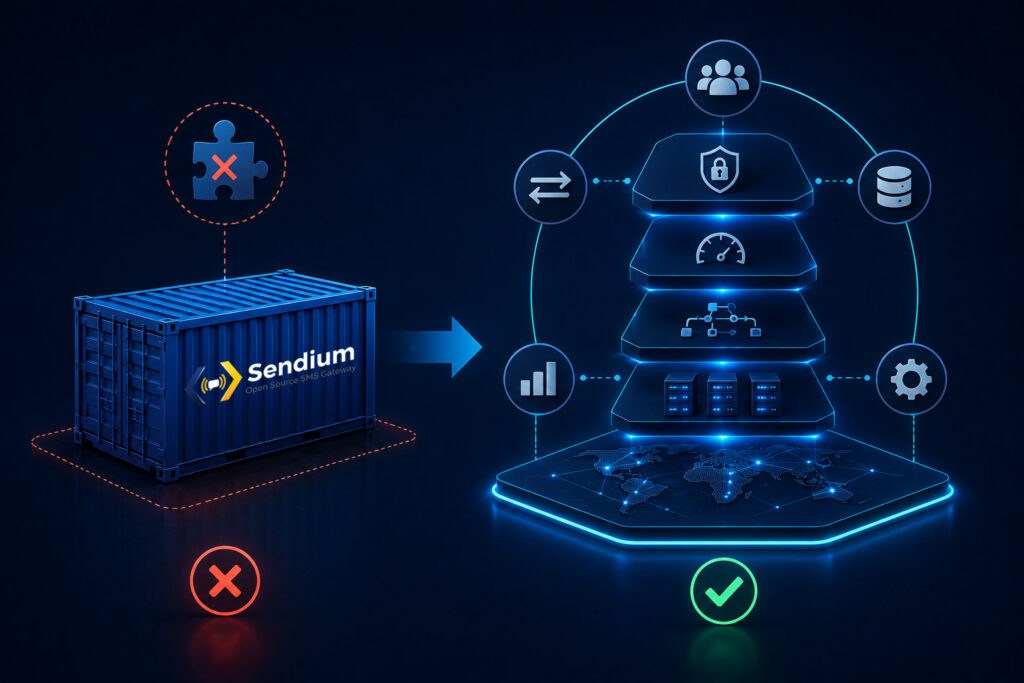
There is also a danger in overselling containerisation.
Docker does not design your routing strategy.
Kubernetes does not decide how much traffic an upstream SMPP connection can accept.
An orchestrator cannot remove a provider’s throughput limits.
Moving a gateway to the cloud does not automatically create redundancy, and running three instances does not necessarily mean traffic can safely be distributed between all three.
Teams still need to think about network connectivity, traffic distribution, provider capacity, persistence, observability, failure scenarios and how individual SMPP connections should behave when infrastructure changes around them.
Containers give engineers better tools for implementing those decisions.
They do not make the decisions unnecessary.
Deploy where the business needs you to deploy
The argument between on-premise and cloud infrastructure is increasingly the wrong argument.
There are valid reasons to run messaging infrastructure in both.
Some organisations need maximum control over data and connectivity. Others want infrastructure that can be provisioned and automated in the cloud. Many will operate somewhere between those two models for years.
An SMS gateway should accommodate that reality.
It should be possible to run it close to your existing telecom connections today without preventing you from changing the surrounding architecture tomorrow.
That is what makes container-native infrastructure relevant to SMS.
Not containers for their own sake.
Deployment freedom.
Sendium is being built as an open-source SMS gateway for teams that want that freedom: control the gateway, control the routes, and decide where the infrastructure runs.
Explore Sendium on GitHub and join the community at sendium.org.