

Table of Contents
When SMS traffic is flowing normally, infrastructure can feel almost invisible.
Messages enter the gateway, routes are selected, connections remain healthy and delivery receipts come back as expected. From the outside, everything appears straightforward.
The real test begins when something changes.
This is where SMS gateway observability becomes critical: not simply knowing that something changed, but understanding where it happened and what caused it.
A provider connection starts behaving differently. Delivery latency increases. Traffic reaches an unexpected limit. A route that was working normally begins rejecting messages. Delivery receipts slow down or stop arriving. Customers report a problem before the operations team has identified where it started.
At that point, SMS gateway observability becomes much more important than simply knowing whether the gateway process itself is running.
Because “the gateway is up” tells you very little about whether the messaging service is actually healthy.
Why SMS Gateway Observability Goes Beyond Uptime
Traditional monitoring often starts with a binary question:
Is the service running?
That is useful, but for messaging infrastructure it is only the first layer.
An SMS gateway sits between multiple moving parts: applications, HTTP interfaces, SMPP connections, routing logic, operators, aggregators and downstream networks. A problem anywhere along that path can affect delivery without necessarily taking the gateway itself offline.
The process may still be running.
The server may still be reachable.
Messages may even still be entering the system.
And yet something important may already be going wrong.
Operational visibility therefore has to answer more specific questions.
Are SMPP sessions connected and stable? Is traffic flowing through the expected connection? Are message submission rates behaving normally? Are providers rejecting traffic? Are delivery receipts coming back? Has a particular route become a bottleneck?
Without that context, troubleshooting quickly turns into guesswork.
The Difference Between “Failed” and “Why It Failed”
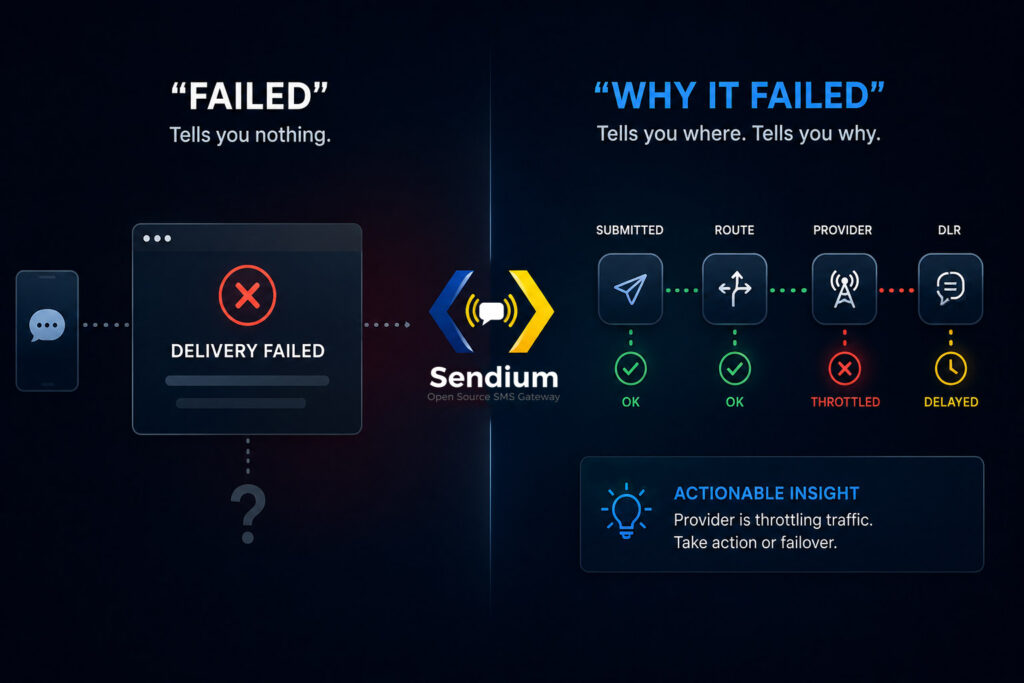
Knowing that a message failed is useful.
Knowing where the failure occurred is operationally much more valuable.
Consider a fairly common situation: an application submits messages successfully, but delivery performance suddenly deteriorates.
Several completely different problems could produce that symptom.
The upstream application may be sending traffic faster than expected. A specific SMPP connection may have reached its configured throughput. A provider may be throttling submissions. Routing behaviour may have changed. The downstream SMSC may be returning errors. Delivery receipts may simply be delayed.
From the customer’s perspective, all of those situations can look like the same problem:
“Our SMS messages are not being delivered properly.”
From an operations perspective, they require very different responses.
That is why observability needs to expose what is happening across the message path rather than reducing the entire system to a green or red status indicator.
Connection Health Matters
SMPP is stateful.
That alone makes connection visibility particularly important in SMS operations.
A connection being configured does not mean it is currently usable. Operators need to understand whether sessions are bound, whether reconnects are occurring, whether traffic is actually moving through them and whether errors are beginning to appear.
Repeated disconnects, authentication failures or unstable sessions can often indicate a problem long before customers begin opening support tickets.
The same applies when several provider connections or customer connections are operating simultaneously.
Without visibility at connection level, identifying the source of a degradation becomes significantly harder.
Good SMS gateway observability makes connection instability visible before it becomes a customer-facing delivery problem.
Throughput Needs Context
TPS is another area where raw numbers can be misleading.
Throughput only indicates pressure when compared with available capacity. A rate of 100 messages per second may be well within one connection’s limits, while 20 messages per second may overwhelm another with a lower configured TPS or provider-imposed limit.
What matters is the relationship between actual traffic and the limits around it.
If a connection is configured for a specific TPS rate, operations teams need enough visibility to understand when traffic is approaching that boundary and what happens when demand exceeds it.
Otherwise, throughput problems tend to appear as vague symptoms: queues grow, latency increases or submissions begin failing.
The question should not simply be:
“How much traffic are we processing?”
It should also be:
“Is that traffic behaving as expected for this connection and route?”
For SMS gateway observability, throughput only becomes meaningful when it can be understood alongside connection limits, traffic volume and provider behaviour.
Delivery Receipts Are Part of the Operational Picture
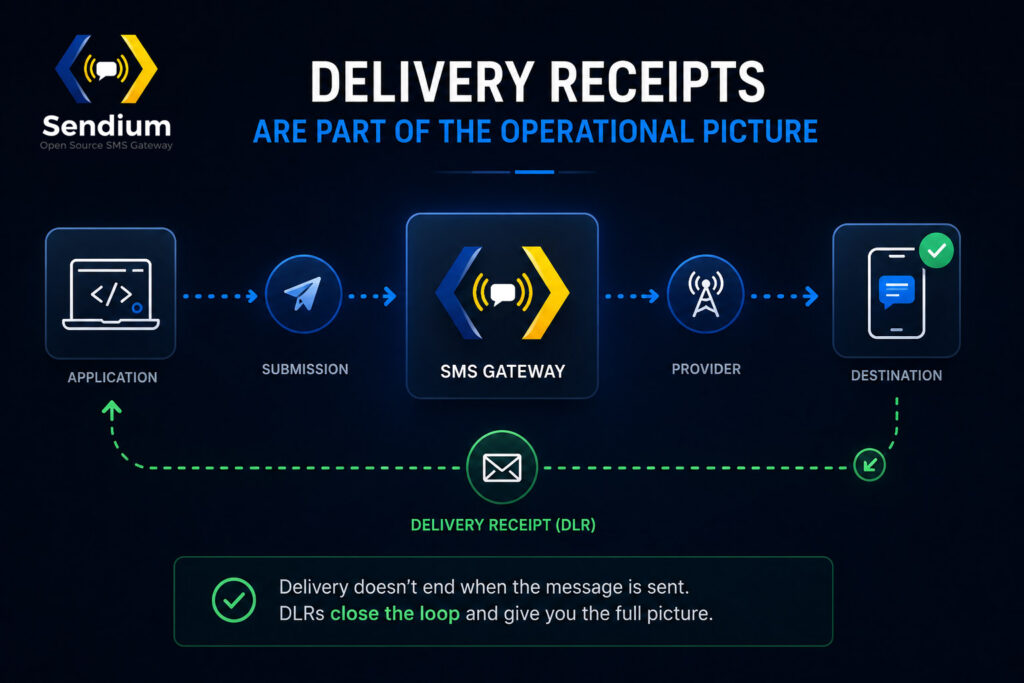
Submitting an SMS successfully is not the same thing as delivering it successfully.
That distinction becomes particularly important when troubleshooting downstream problems.
A provider may accept a message while the final delivery result arrives later through a delivery receipt. Delays or abnormalities in that DLR flow can reveal issues that are invisible at submission time.
If operations teams only observe the initial submission, they see only part of the lifecycle.
A more useful operational view connects submission behaviour with what happens afterward.
Were messages accepted?
Are delivery receipts returning?
Are they returning within the expected timeframe?
Are specific error states suddenly becoming more common?
That context can make the difference between identifying a provider-side issue quickly and spending hours investigating the wrong part of the infrastructure.
That makes DLR behaviour an important part of SMS gateway observability, not simply a reporting feature.
Routing Visibility Reduces Troubleshooting Time
Routing introduces another layer of complexity.
Once traffic can move through different connections depending on rules, destinations or operational conditions, the ability to understand the path a message took becomes critical.
When an unexpected delivery issue appears, one of the first questions is often:
Which route handled the traffic?
If that answer requires reconstructing the system manually from configuration files, application logs and provider reports, diagnosis becomes unnecessarily slow.
Routing should not become a black box between message submission and provider delivery.
Operations teams need enough context to correlate routing decisions with connection behaviour and downstream results.
That becomes increasingly important as messaging environments grow beyond a single application connected to a single SMS provider.
Effective SMS gateway observability should therefore make routing behaviour part of the operational evidence available during an investigation.
Logs Are Useful. Correlation Is Better.
Logs remain one of the most important tools in infrastructure operations.
But having a large amount of log data does not automatically mean a system is observable.
The useful question is whether those events can be connected.
A message entered through an HTTP request.
It was processed by the gateway.
A route was selected.
It was submitted through a particular SMPP connection.
A response came back.
Later, a delivery receipt arrived.
When those events can be correlated, troubleshooting becomes a process of following evidence.
When they cannot, engineers end up searching separate logs and trying to reconstruct the lifecycle manually.
That difference matters enormously during incidents.
Build the Gateway Into Your Observability Stack
Modern infrastructure teams rarely operate a messaging gateway in isolation.
They already have monitoring, logging and alerting systems covering applications, containers, hosts, databases and network services.
The SMS gateway should fit into that operational model.
That does not necessarily mean the gateway itself needs to become another giant dashboard.
What matters is that operators can expose and consume the information required to understand its behaviour: connection status, traffic activity, throughput constraints, errors, routing context and message lifecycle events.
This is particularly relevant in containerised and distributed environments, where the gateway may be only one component within a much larger application stack.
The objective is not to create more monitoring.
It is to make existing monitoring more useful.
The objective of SMS gateway observability is not to create another isolated monitoring environment, but to make messaging infrastructure understandable inside the operational stack teams already use.
Observability Should Shorten the Incident
The value of observability becomes clearest when something breaks.
Without enough context, the incident starts with questions:
Is the application sending traffic?
Is the gateway processing it?
Which route is being used?
Is the SMPP session connected?
Is the provider throttling us?
Are DLRs delayed?
Is the problem affecting all traffic or only one destination?
Every unanswered question adds time.
Good observability reduces that uncertainty.
Instead of investigating every component simultaneously, the operations team can narrow the problem down quickly and focus on the part of the message path that is actually behaving abnormally.
That is the practical difference between monitoring infrastructure and understanding it.
Where Sendium Fits
Sendium is designed as a headless, open-source SMS gateway that can become part of a wider operational stack rather than forcing teams into a predefined management interface.
Its role is the messaging layer: accepting traffic, handling SMPP and HTTP connectivity, applying routing logic, controlling throughput per connection and providing the operational context needed around those processes.
That allows teams to integrate messaging infrastructure into the monitoring and logging systems they already use, whether Sendium is deployed on-premises, in the cloud or inside a containerised environment.
Because when SMS infrastructure becomes business-critical, operators should not have to guess what the gateway is doing.
They should be able to see the evidence.
Containers do not replace architecture
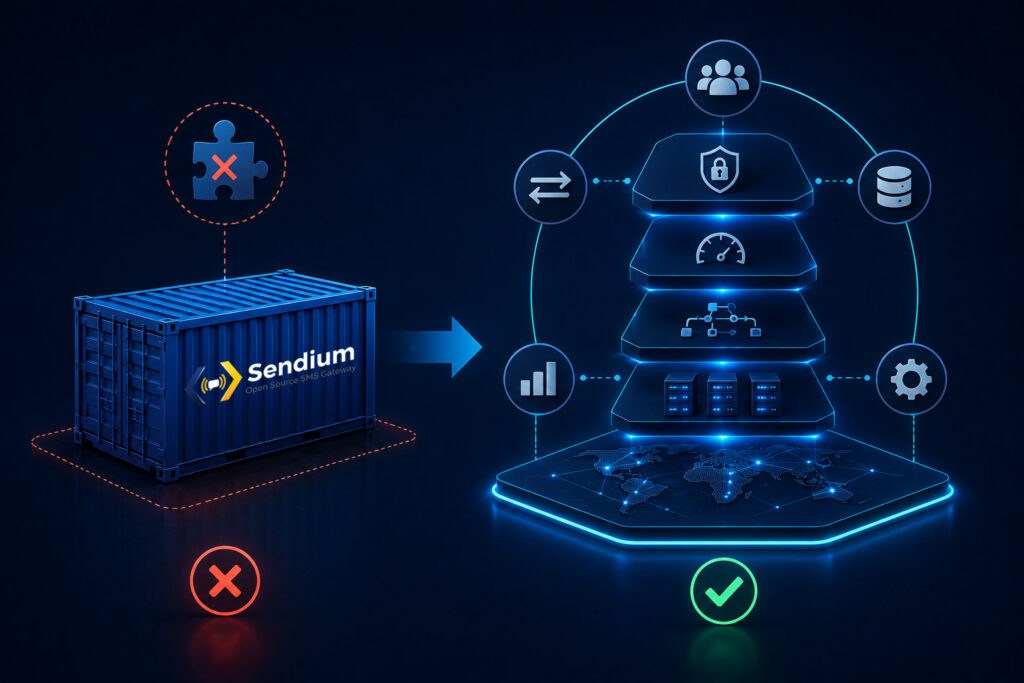
There is also a danger in overselling containerisation.
Docker does not design your routing strategy.
Kubernetes does not decide how much traffic an upstream SMPP connection can accept.
An orchestrator cannot remove a provider’s throughput limits.
Moving a gateway to the cloud does not automatically create redundancy, and running three instances does not necessarily mean traffic can safely be distributed between all three.
Teams still need to think about network connectivity, traffic distribution, provider capacity, persistence, observability, failure scenarios and how individual SMPP connections should behave when infrastructure changes around them.
Containers give engineers better tools for implementing those decisions.
They do not make the decisions unnecessary.
Deploy where the business needs you to deploy
The argument between on-premise and cloud infrastructure is increasingly the wrong argument.
There are valid reasons to run messaging infrastructure in both.
Some organisations need maximum control over data and connectivity. Others want infrastructure that can be provisioned and automated in the cloud. Many will operate somewhere between those two models for years.
An SMS gateway should accommodate that reality.
It should be possible to run it close to your existing telecom connections today without preventing you from changing the surrounding architecture tomorrow.
That is what makes container-native infrastructure relevant to SMS.
Not containers for their own sake.
Deployment freedom.
Sendium is being built as an open-source SMS gateway for teams that want that freedom: control the gateway, control the routes, and decide where the infrastructure runs.
Explore Sendium on GitHub and join the community at sendium.org.