

Table of Contents
SMS delivery receipts are not an afterthought in modern SMS infrastructure.
Sending a message is only the beginning of the operation. The more important question often comes later: what happened after the message left the gateway?
A message may be accepted by the gateway, submitted to a provider, forwarded through an SMPP connection, routed toward a mobile network and eventually delivered, rejected, expired or left in an uncertain state. From the perspective of the application that initiated the message, all of this may happen after the original request has already returned a successful response.
That is why delivery receipts matter.
They are not a decorative feature added after message submission. They are part of the feedback loop that allows operators, platforms and customers to understand whether SMS delivery is actually working as expected.
Submission Success Is Not Delivery Success
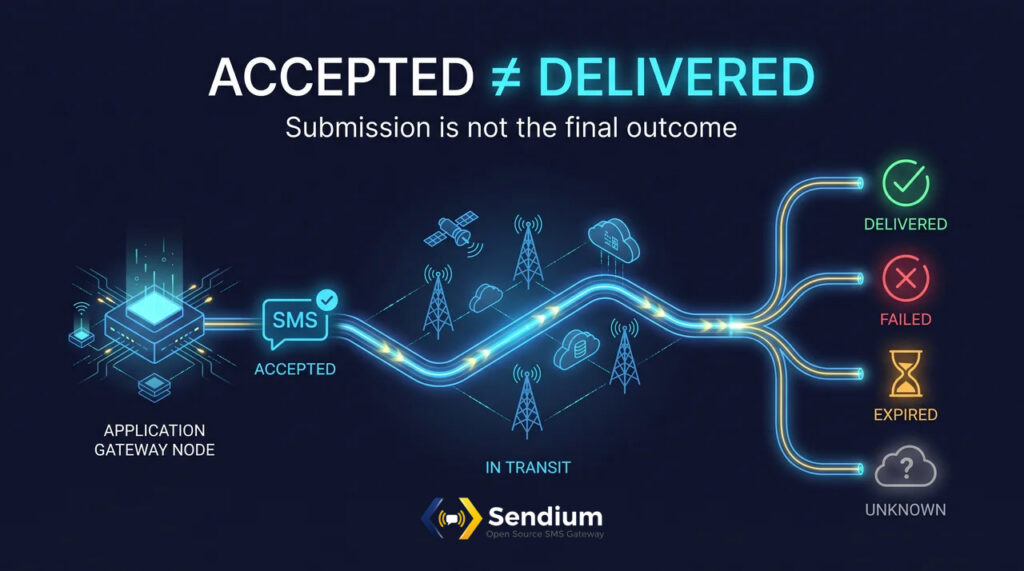
One of the most common misunderstandings in SMS operations is the idea that a successful submission means the message has been delivered.
It does not.
A successful submission usually means that the next system in the chain accepted the message for processing. That may be the gateway, an upstream provider, an SMSC or another intermediary. It is an important step, but it is not the final outcome.
Delivery is asynchronous. The final status may arrive seconds later, minutes later, or in some cases not arrive at all. Between submission and final delivery, the message can pass through several systems, each with its own behavior, timing and status semantics.
This distinction is operationally important. If a platform treats submission success as the end of the process, it has very limited visibility into the quality of the delivery path. It may know that messages were sent out, but it does not really know whether they reached the destination, failed downstream or expired before completion.
Delivery receipts exist to close that gap.
DLRs Are Part of the Message Lifecycle
SMS delivery receipts become useful only when the gateway can connect them back to the original message and expose that status clearly to the surrounding platform.
A delivery receipt is not separate from the message. It is part of the message lifecycle.
When a gateway submits traffic through the SMPP protocol, it often receives later feedback about the status of that message. That feedback may indicate delivery, failure, expiry, rejection or another provider-specific state. For the gateway, the challenge is not only to receive that information, but to connect it back to the original message in a reliable way.
This is where DLR handling becomes more than basic status processing.
The gateway needs to understand which original message the receipt belongs to, what status it represents, whether that status is final, and how that information should be exposed to the rest of the platform. In A2P messaging environments, this feedback may affect reporting, customer notifications, retries, billing logic, support investigations and operational monitoring.
If delivery receipts are handled poorly, the platform may still be able to send messages, but it becomes much harder to explain what happened after submission.
That creates operational blind spots.
Not All Delivery Receipts Mean the Same Thing
Delivery receipts are not always as clean as operators would like them to be.
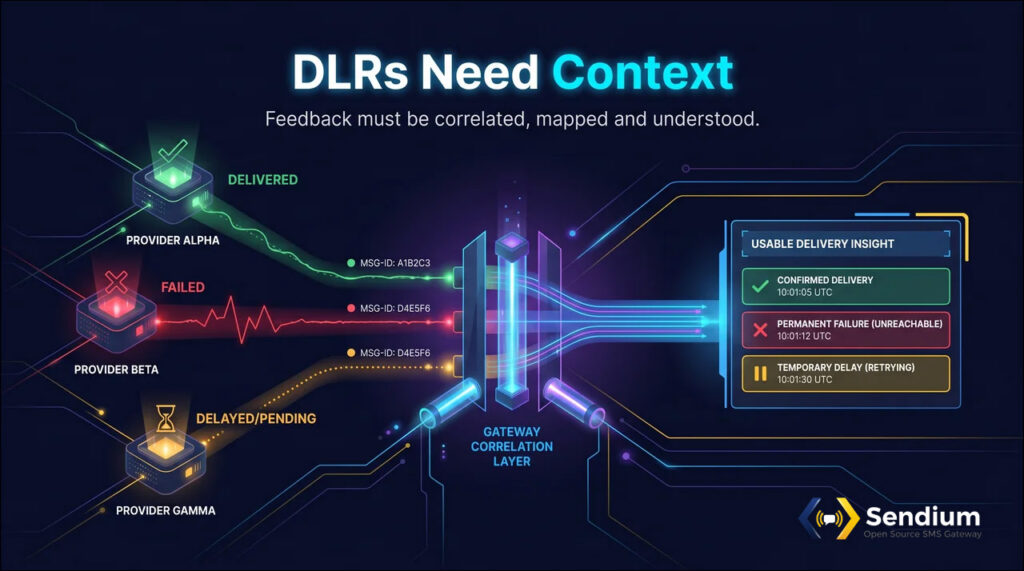
Different providers may expose different status values. Some may return detailed error information, while others may provide only limited feedback. A delivered status from one route may not be formatted exactly like a delivered status from another. Failure reasons may be specific, generic or difficult to map cleanly into the platform’s own reporting model.
This is not unusual in SMS infrastructure.
A gateway often sits between application-facing systems and provider-facing connectivity. It has to translate between the expectations of the application and the reality of upstream delivery feedback. That translation needs to be handled carefully, because oversimplifying receipt states can hide useful information, while exposing every provider-specific detail directly can make reporting inconsistent and hard to interpret.
The goal is not to pretend that all receipts are identical.
The goal is to make delivery feedback usable.
That means preserving enough detail for operational investigation while presenting status information in a way that customers, support teams and platform operators can actually work with.
Timing Matters
Delivery receipts also have a timing dimension.
A receipt that arrives quickly gives the platform confidence sooner. A receipt that arrives late may still be valid, but it changes how the message should be interpreted by the business process behind it. For some traffic, a delayed delivery receipt may be acceptable. For other traffic, especially time-sensitive messages, late feedback can be almost as important as failure.
Consider an authentication message. If the user receives the code too late, the technical status may eventually say “delivered”, but the user experience may still have failed. In that case, delivery feedback alone is not enough. The timing of the feedback also matters.
This is why DLR handling should not be viewed only as a database update.
It is part of how the platform understands delivery behavior over time. Receipt timing can reveal route quality issues, provider delays, downstream congestion or destination-specific problems that are not visible from submission responses alone.
A gateway that treats delivery receipts seriously can help teams see those patterns earlier.
SMS Delivery Receipts Support Better Operations
DLRs become especially valuable when teams need to investigate what happened.
A customer may report that messages are not arriving. A campaign may show lower performance than expected. A specific route may appear healthy from a connection perspective but still produce poor delivery outcomes. In those moments, operators need more than submit logs.
They need delivery evidence.
Delivery receipts help connect the operational chain. They allow teams to compare submission volume with delivery outcomes, understand failure patterns, and distinguish between gateway issues, provider behavior and downstream delivery problems. Without that feedback, teams are forced to reason from incomplete information.
This matters because SMS incidents are often not obvious at first glance, especially when fallback routing, provider behavior and delayed delivery feedback are all part of the same operational picture. A connection can remain active while delivery quality changes. Traffic can continue to flow while traffic pressure builds and receipts show increasing failures or delays. A provider can accept submissions while downstream delivery becomes unreliable.
DLRs help expose the difference between traffic movement and delivery outcome.
That difference is critical.
DLRs Should Be Connected to Routing Decisions
Delivery receipts are also relevant to routing strategy.
If one provider consistently returns poor outcomes for a destination, that information should influence how operators think about routing. If another route produces better delivery behavior, the gateway layer should make it possible to evaluate that difference. Over time, delivery receipts can become one of the signals that helps teams understand which routes are actually performing well.
This does not mean every DLR should automatically trigger a routing change. That would be too simplistic and could create instability.
But receipt data should not be ignored either.
A routing strategy based only on connectivity and submission success is incomplete. Provider behavior after submission matters. Delivery outcomes matter. Receipt timing matters. When those signals are available, they give operators a more realistic view of route quality.
In mature SMS operations, routing and delivery feedback are connected parts of the same system.
Delivery Feedback Should Not Become a Black Box
A delivery receipt is useful only if the platform can make sense of it.
If DLR processing is hidden, inconsistent or difficult to inspect, teams may struggle to understand why a message received a specific status. They may see a final result in a report without being able to trace how the gateway interpreted the original provider receipt. This can create problems during customer support, incident analysis and operational tuning.
A good gateway should make delivery feedback understandable.
That does not necessarily mean exposing everything through a graphical interface. In many infrastructure environments, what matters more is that the gateway processes receipts consistently, preserves relevant information, and makes status behavior available to the systems and teams that depend on it.
For developers, this can mean clean forwarding of delivery status. For operators, it can mean reliable correlation between submissions and receipts. For customer-facing platforms, it can mean reporting that reflects the actual delivery lifecycle instead of stopping at submission.
The important point is that DLRs should not disappear into the background.
They should remain part of the operational picture.
Why This Matters for A2P Messaging
In A2P messaging, delivery outcomes are tied directly to customer trust.
Businesses use SMS for authentication, alerts, reminders, notifications, marketing and operational communication. In many of these cases, they do not only need to send messages. They need to know whether those messages reached their intended destination, whether they failed, and whether delivery happened within a useful time window.
This is why delivery receipts are not just a technical detail.
They affect service quality, customer support, reporting accuracy and commercial confidence. A platform that cannot explain delivery outcomes will eventually struggle to explain its own reliability.
That becomes even more important as traffic grows, more providers are added, routing becomes more complex and customers expect clearer reporting. The more distributed the delivery chain becomes, the more important the feedback loop becomes.
DLRs are one of the ways the gateway brings that feedback back into the operation.
Where Sendium Fits
For Sendium, SMS delivery receipts are part of the broader gateway feedback loop that connects message submission, routing behavior and delivery outcome.
Sendium treats the SMS gateway layer as an operational control point, not only as a place where messages pass from one protocol to another.
That matters for delivery receipts because DLRs sit at the intersection of protocol handling, message correlation and operational visibility. A gateway that supports SMPP connectivity needs to handle the feedback that comes back through that connectivity, not only the original submission flow.
In practical terms, delivery receipt handling should help teams understand what happened to a message after submission. It should support the connection between the original message and the later delivery status, and it should allow that status to become useful to the surrounding platform rather than remaining buried inside provider-specific behavior.
For Sendium, this aligns with the broader goal of open and understandable SMS infrastructure. Operators should be able to reason about message flow, routing behavior and delivery feedback as connected parts of the same gateway operation.
You can also explore Sendium on GitHub and follow how the project evolves around open SMS gateway infrastructure.
Sending the message is only one side of the story.
Knowing what happened next is the part that makes SMS infrastructure operationally accountable.
That is why delivery receipts are not an afterthought.